Cascade Control Interactions
When tuning cascade control loops, the outer loop should be tuned “significantly” slower than the inner loop. This is to separate the dynamic response times of the two loops so they don’t interact with each other.
There are various measures of loop response time, and it does not matter which one you choose in this case, as long as it reflects the speed of response of the two loops in automatic (closed loop) control. For example, you can use the closed-loop time constant, which is the length of time the process variable takes after a set point change to progress 63% of the way toward the new set point.
You should step test and tune the inner loop first and then measure its response time after a set point change. After this you should step test and tune the outer loop, measure its response time after a set point change, and make sure it is significantly slower than the inner loop.
There is inconsistency around how much slower the outer loop should be. Some texts say 3 – 5 times, some say 5 – 10 times. Someone on LinkedIn’s Automation & Control Engineering group recently said it should be 3.32 times and some Mr. Altmann reportedly said it should be 20 times. I have not seen anyone explain in understandable terms what the underlying basis of their numbers is.
Here’s the deal: They are all somewhat right (except Altmann with his 20 times), because the degree of separation required depends on how aggressively you tune the two loops. The more aggressive your tuning, the further from each other the loops’ dynamic responses should be separated to prevent interaction between the loops.
If you tune for quarter-amplitude damping response (very aggressive tuning – don’t do it), loops tend to be very oscillatory and interactive. Then the outer loop should be tuned to respond at least 5 times slower than the inner loop. This is where the 5 to 10 times rule comes from. If you use the Lambda (IMC) tuning method on both loops, you can easily get by with the outer loop responding only 3 times slower than the inner loop, hence the 3-times rule.
Here is a summary:
| Tuning Objective/Rule | Factor that outer loop must be slower than inner loop |
| Quarter-amplitude damping | Minimum of 5 times |
| Lambda (IMC) with open loop time constant = closed loop time constant (Lambda factor of 1) | 3 to 5 times |
| Lambda (IMC) with open loop time constant = 3 x closed loop time constant (Lambda factor of 3. This is a very stable, but the loop is sluggish) | 2 to 3 times |
A Point worth Pondering!
Normally you should step test the inner loop and tune it for a somewhat fast response. Not quite quarter-amplitude damping, but maybe half as fast as that (divide by two the controller gain calculated for quarter-amplitude damping response). Then, step test and tune the outer loop. Now, if you have to detune the outer loop to slow it down to meet the criteria above, you should seriously question the benefit of using cascade control in this application. You may be better off having the “outer” loop drive the control valve directly.
Case Study:
A power plant had problems with coal-mill temperature control. Coal mills are used to grind coal into a powder for combustion in the boiler. The mill design they had is called a ball mill – hundreds of steel balls in a rotating cylinder pulverize the coal. Air is used to transport the pulverized coal from the mill, through pipes, to the burners. Because the coal is often moist, hot air is blown into the mill to dry the coal (and transport the powder). To ensure sufficient moisture is driven off, the mill’s outlet temperature is controlled at a set point around 75 °C (167 °F).
This plant’s mills each had two dampers for air temperature control: one damper controlled cold air and another controlled hot air. They were configured so that the hot air damper would open from 0 to 100% while at the same time the cold air damper would close from 100 to 0%. The mills had inlet and outlet temperature sensors. Each mill had a cascade-control arrangement in which the outer loop controlled the mill outlet temperature, and the inner loop controlled the mill inlet temperature. The temperature control was either very sluggish, or it was oscillating, or both.
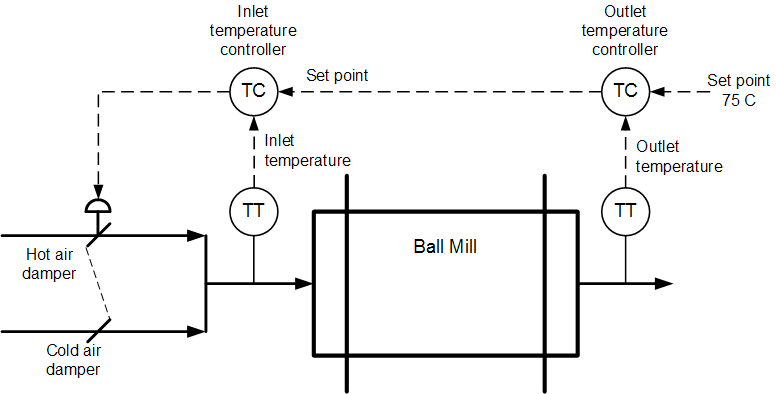
Cascaded Mill Temperature Control
After some step-testing and tuning we discovered the problem. The process dynamics of the outer loop was only marginally slower than that of the inner loop. So when the plant personnel tuned the loops based on step-test data, their tuning settings were very similar for both loops, making the loops oscillate against each other (they said the loops were fighting each other). If they slowed down the outer loop to stabilize the loops, the temperature control became very sluggish.
The solution was to not use cascade control at all. We removed the inner loop from all mills and had the outer loop directly manipulate the dampers. Then we could tune the single temperature control loop for a fast, but stable response without interactions with an inner loop. The problem was solved.

Redesigned Mill Temperature Control
Contact me if you are interested in on-site training for your controls group, or if you have loop optimization problems (jsmuts@opticontrols.com).
Stay tuned!
Jacques Smuts – Author of the book Process Control for Practitioners